
Why This Is Not Optional Anymore
The timeline is no longer theoretical. A voluntary phase ran from 2024, the readiness assessment deadline of 31 July 2026 has now passed, and mandatory IFRS S1 and S2 reporting begins for Public Interest Entities on 1 January 2027 - with large non-PIEs following in 2028 and SMEs in 2029. Deposit-taking SACCOs, all 178 of them licensed by SASRA, sit inside ICPAK's Public Interest Entity definition alongside listed companies, banks, insurers, fund managers and pension schemes. That places them in the very first mandatory wave, whether or not they are listed or hold public deposits in the way a bank does.
The urgency is sharpened by where the sector currently stands. National readiness averages just 1.51 out of 4, rated "Emerging" - most institutions still lack a Board-approved ESG policy, a designated ESG champion, emissions data, or the systems to collect it. For institutions that move now, this is a genuine first-mover advantage over the January 2027 deadline. For those that wait, it becomes a scramble against a standard that connects directly to the audited financial statements they already produce annually.
What IFRS S1 and S2 Actually Require
IFRS S1 sets out general sustainability disclosure requirements built around four pillars: governance, strategy, risk management, and metrics and targets. Its most consequential requirement is connectivity - sustainability information must tie directly into the financial statements, not sit beside them as a separate narrative report. For institutions that already undergo mandatory annual audits, this is the real step-up: the scope, data and governance demanded by full disclosure go well beyond what current audit processes cover.
IFRS S2 layers climate-specific requirements on top, principally greenhouse-gas reporting across Scope 1, Scope 2 and material Scope 3 emissions. Assurance is phasing in progressively - limited assurance first, moving towards reasonable assurance under ISSA 5000 - which means the underlying data and evidence trail need to be audit-ready well before the assurance engagement itself begins.
Where Climate and Governance Risk Actually Sit
For SACCOs, climate risk lives in the loan book rather than in head office operations. Agriculture, transport and rural SME lending, alongside property and infrastructure investments, carry physical and transition risks that IFRS S2 puts squarely in focus. The governance gap is just as material: few institutions currently have a Board-approved ESG policy, a designated ESG committee, or a champion accountable for the reporting programme - the foundational pieces IFRS S1's governance pillar requires before any disclosure can be credible.
For pension schemes, the same framework extends naturally to the investment portfolio - embedding ESG considerations in the investment policy statement, running portfolio-level climate screening, and equipping trustees through targeted training. This is the same governance and asset-liability thinking that already shapes sound investment oversight; IFRS S1 and S2 simply require it to be documented, measured and disclosed formally.
“IFRS S1 and S2 do not ask SACCOs and pension schemes to invent a sustainability story. They ask institutions to structure the one they are already living, and prove it.”
- Niloyd Associates ESG & Compliance Practice
Turning Compliance Into a Credible Sustainability Story
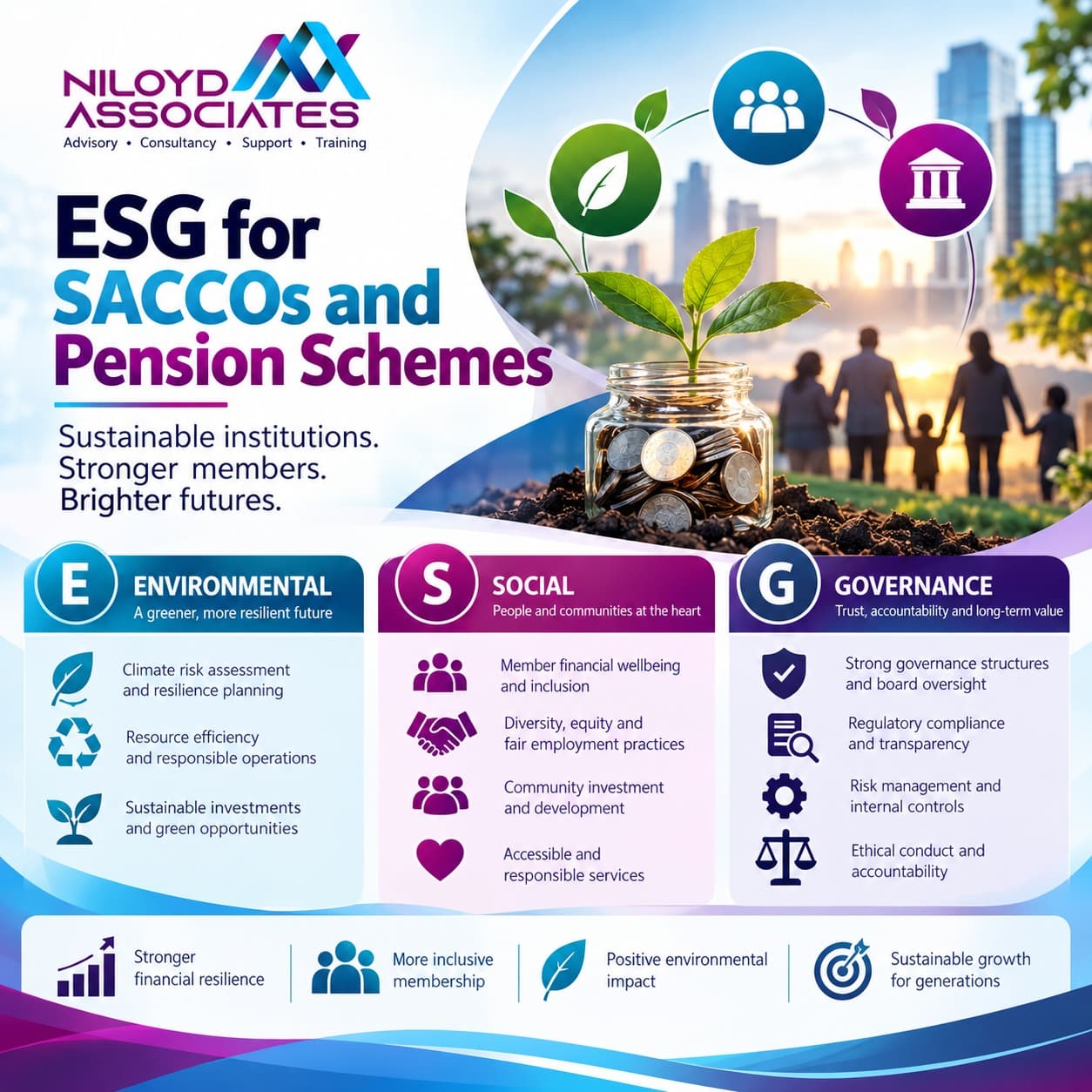
SACCOs already have a genuine ESG story: member welfare, financial inclusion and community development sit at the core of the cooperative model. The task is not inventing sustainability commitments from nothing - it is structuring what already exists into performance that can be measured, disclosed and, eventually, audited.
Locally, that structure can anchor on frameworks institutions already operate within - the Sacco Societies Act 2008, SASRA's governance and risk management guidelines, and the RBA Good Governance Practices Guidelines for pension schemes. The CBK Climate Risk Guidance, the Kenya Green Finance Taxonomy and the NSE ESG Disclosures Guidance Manual do not bind SACCOs directly, but they signal the direction Kenyan regulation is moving and remain the most relevant local benchmarks available today.
A Practical Path From Readiness to Assurance
A workable programme runs in stages: a diagnostic gap assessment against every IFRS S1 and S2 requirement, followed by foundation building - a materiality assessment, an integrated ESG risk register, governance design, and a greenhouse-gas inventory covering Scope 1, 2 and material Scope 3. From there, disclosure drafting connects the sustainability narrative to the financial statements, and an assurance-readiness review under ISSA 5000 prepares the institution for external scrutiny. Capacity building runs throughout, so the reporting capability stays in-house rather than depending on a consultant every cycle.
The starting point is always governance: a Board or trustee resolution authorising the programme, followed by a focused scoping conversation and a delivery schedule that fits the institution's existing governance calendar. Built this way, ESG reporting becomes part of how the institution already operates, not an exercise layered awkwardly on top of it.

Key insights
You are already a Public Interest Entity
ICPAK's Public Interest Entity definition names SASRA-regulated deposit-taking SACCOs alongside listed companies, banks, insurers, fund managers and pension schemes - placing them in the first mandatory reporting wave regardless of size or listing status.
Assurance is phasing in, not staying optional
IFRS S1 requires sustainability disclosures to connect directly to the financial statements, and assurance moves from limited to reasonable under ISSA 5000. A standalone narrative report will not satisfy either standard.
The 'S' and 'G' already exist - they need structuring
Member welfare, financial inclusion and community development are already part of the cooperative model. The work is turning that lived experience into disclosable, auditable performance - while climate risk sitting in agricultural, transport and property lending gets proper attention under IFRS S2.
Conclusion
The compliance deadline is fixed, but the outcome is not - institutions that begin now will meet January 2027 with a credible, board-ready sustainability story; those that wait will be assembling one under pressure, against a standard that reaches directly into their audited financials. Niloyd Associates brings ESG specialists, actuaries, sustainable finance and data analytics professionals, risk management specialists, and CPA(K) auditors under one roof to support SACCOs and pension schemes through readiness assessment, governance and GHG inventory build-out, disclosure drafting, and assurance preparation across Kenya and East Africa.

Have a question about this topic? Our advisors are available to discuss specific mandates and regulatory questions.